Sunday, 11 March 2018

Organisational Growth


Business is growing and you need more people to handle the increased demand.  You hire a new member of staff to grow an existing team to handle that increased demand, obviously you put them with that team and the team size has just increased by one.

Demand for your services continues to grow and even more people are required to handle that increased demand.  Naturally, you hire a new member of staff for the team, and a new one, and a new one.  If you keep adding them to the team then the team will just get bigger.  As the team gets bigger the number of paths of communication increase.  The team also begins to function less like the team of old, cliques form and the team's identity is fractured.

What went wrong?

There are a number of options to be considered whenever one increases the number of staff within a department - increasing the number of accountants and lawyers is two separate areas (accountants and lawyers) unless you have cross-functional teams.  So let's re-frame the situation as increasing the number of staff within a collection of related teams (each team may have a single function or be cross-functional, but if the teams have a single function then you have multiple teams with the same single function), therefore there are three options:
  1. new starters are distributed across all existing teams
  2. new starters join a new team only for new starters
  3. new starters are allocated to one team only

Let's explore each of these options in turn.

Distributing new starters across all existing teams means that each team will face the disruption and overhead of incorporating a new member into their team and training them in the team's way of doing things.  It also means that all teams will increase in size.  If this is only a short term modest increase of only 1 or 2 people per team then it may have no adverse effect on team function.  However, if you keep hiring new staff and distributing those new starters across the existing teams then you will eventually face the situation where all of your teams have begun to reach that critical moment when they are "too" large to function as effectively as they had done previously.

Instead of distributing all new starters across all teams you can put all new starters into a team consisting only of new starters.  If the new starters team has no established staff working with it then it is on its own, forging its own way, making its own mistakes, and creating a potentially distinct identity quite separate from all the existing teams, but at least none of the existing teams are affected by having to train the new starters, at least not directly.  With some guidance from an existing member of an established team then the team of new starters will not be left completely to its own devices.

The third option was to allocate new starters to just one existing team.  New starters would be trained on the job just like if they were distributed across all the existing teams, but now only one team has the disruption of having to form, storm, and norm with the introduction of each new starter.  Eventually that team will have to split once that critical moment of being "too large" is reached, but this will only happen for one team, not every single time as would be the case in the first option where new starters are distributed across all existing teams.  Splitting the team will still have some degree of forming, storming, and norming associated with it, but that is minimised if the nucleus of the team is split, amoeba-like at the same time, where the nucleus consists of two or more established members of the original team.

Are there other options?  Possibly some mixture of the 3 options.

Which option makes the most sense?  That depends on the system to which you are going to make the changes.

Teams are not amoebas.

Wednesday, 7 February 2018

Visual Studio Code: it does more than you'd expect

Visual Studio Code is great, just great.

Having previously been a big user of Visual Studio I was rather dismissive of Visual Studio Code - it's just an editor for Macs, isn't it?  Anyway, since seeing it in action in the technical sessions at the Microsoft Tech Summit in Singapore I knew it was now a lot more than a simple editor and was a credible rival to Visual Studio.

So, I downloaded it, started installing it, ticked all the boxes, and set about playing with it.

Some time later I noticed that when trying to open some folders in Windows Explorer that Visual Studio Code would open.  This was odd - who on Earth would always want to open Visual Studio Code when double-clicking on a folder in Windows Explorer?

Investigating a bit further I saw that "Open with Code" was the top and default entry for the context menu for folders in Windows Explorer.  So how to disable this?

I turned to Mr Google, and after a bit of browsing I came across this:
http://thisdavej.com/right-click-on-windows-folder-and-open-with-visual-studio-code/

The article describes itself thus:
Today’s topic is aimed at Windows users who are using Visual Studio Code and want to be able to right click on a given folder and launch VS Code.  We’re going to add a right click context menu item to “Open Folder as VS Code Project” since it saves time—and it’s more fun!
However, I want the reverse.  I want to stop Visual Studio Code from always opening when I want to open a folder in Windows Explorer.

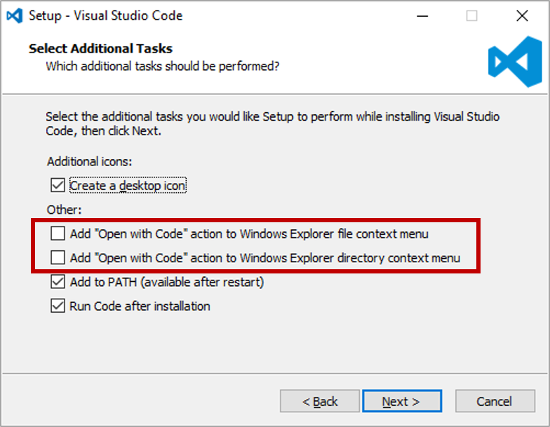
What appears to have happened was that in my eagerness to install Visual Studio Code and ticking all the boxes I'd ticked too many boxes.  Namely, I'd ticked but not properly read these options:
http://thisdavej.com/wp-content/uploads/2016/03/VSCodeInstall.png

Rather than uninstalling and re-installing Visual Studio Code I wanted something that was less time consuming.  Anyway, the solution is to remove the correct entry from the registry, namely:
HKEY_CLASSES_ROOT\Directory\shell\vscode
 With that entry gone I can now open folders in Windows Explorer as intended, and I can still select "Open with Code" from the navigation pane.  Huzzah!

Tuesday, 30 January 2018

Conversational UI in Singapore

Went to the inaugural meeting of Chatbots SG this evening.

As is traditional I have to say something about the catering: there was no food, only drinks, so I took my seat.  My seat had a freebie: Slack socks.  I tried them on later and fortunately they weren't slack socks.


The venue wasn't too bad, but I do find that the Block 71 area is rather earnestly hip and trendy.

Anyway, I went there to listen to what people had to say about chatbots, or conversational UIs as nobody described them.  We did learn that the group had been set up "by accident", but didn't get more detail on that story.  Anyway there were talks by people representing a number of organisations, so here goes.

Slack

OK, so we start with the sales/marketing pitch.

The premise presented for chatbots in Slack is that one does not have to build a new app or web site with forms, menus, etc, instead one can use Slack conversations (and buttons) as the UI.

What did we learn?

  • walkiebot.co is great for prototyping conversations
  • dashbot's chatbots analysis reported that  4/5 of chatbot users prefer textual engagement over buttons
  • someone in the audience said "algo" instead of algorithm - it sounds equally as bad as people saying "geo" instead of geography
  • unfortunately, we didn't manage to get any roadmap secrets

We also learnt that Slack are now introducing forms, menus, etc. to their chatbot toolbox.  Remember those?  They're the kinds of things that you get on the apps or web sites that you might otherwise build instead of using a chatbot...

osome

(I have to stop thinking of the AWESOM-O 4000 when I hear the name.)

What did we learn?

  • if people want to do something quick & easy then they prefer self service
  • if people want to do something complicated then they prefer a live agent

One of the audience questions touched on data privacy, which is always something that organisations handling personal data need to be aware of, particularly when it comes to the various pieces of personal data protection legislation.

Bus Uncle

Known as Singapore's favourite chatbot, I'd never heard of it before, partly because it's on Facebook.  Having seen the demonstrations of it I can understand why it's the favourite: the developers paid attention to the user experience.  Bus Uncle uses local vernacular and has a personality.

The developers had also developed a chatbot for visitors to Indonesia, which then raised the area of potential movement towards bot-to-bot conversation, or effectively referrals from one bot to another.

The Bus Uncle chap did mention that they have adverts embedded in conversations... hmmm, product placement.  They do need to make money to pay for this, but I hope it's done well.

And Finally

The pizza arrived, but I needed to go home...

Thursday, 25 January 2018

"What happens to HR in an agile journey?"


I'm at another Agile Singapore meetup, this time in Titansoft's offices - ah the smell of freshly-decorated office, it's so... cephalagic.  Anyway, I'm in Titansoft's offices listening to Titansoft's HR & Operations manager talk about what happens to HR in an Agile journey and I'm taking notes with a Titansoft 3-colour pen I'd picked up at a conference a couple of years ago.  I'm not, however, wearing a Titansoft T-shirt, nor a T-shirt with Titansoft's name on there as one of the sponsors - basically, I'm not wearing a T-shirt.

This is a talk about a journey, so there are travellers on that journey who encounter obstacles and have to navigate twists and turns along the way.  Not everyone was ready for the journey, people were happy where they were, but then difficulties were found with their situation at the time, and there were voices in the distance indicating a new and different situation that might just be better.  Along the journey some people found particular paths to be hard-going, particularly when they were still carrying so much other baggage that made it harder to navigate those narrower paths.  The main path was quite wide and generally inviting, but it was mostly muddy - sticky and slippery, not the kind of ground you want when you're carrying that historical baggage.  Not everyone followed the same paths, but each group seemed to find what most suited them, or what they were most comfortable with, or rather what became their new comfortable situation.

What stuck out?

Kids today(*) want their work experience to include the following: autonomy, flexible working hours, learning opportunities and challenges, meaningful work, and frequent feedback.  I don't know why that list should be exceptional, they're all the kinds of things that I like to find in an employer, and I'm supposed to be a member of Generation X.

So much like Plato's reporting of Socrates' complaints against the youth of 2400 years ago, the comments about the kids of today would appear to be the same view of every generation.

There was one other desire that the younger workers want from their work experience: early promotion.  Though history is littered with stories of ambitious (and exceptional) young characters who found early promotion, the emphasis is on them being exceptional, which is also why there are stories about those characters in the first place.

This is something I have trouble with because it potentially sets up an unrealistic set of expectations for repeated promotions.  If so, then there are going to have to be many more rungs on the promotion ladders than there are now - you want to move up from Junior Assistant Junior Clerk to Assistant Junior Clerk and then on to Senior Assistant Junior Clerk?

Surely there was more about HR in general?

I was struck by some of the default mindsets that I'd deduced from the presentation.  (It was only an hour's presentation and I did not grill the speaker so I may be wrong in some of my assumptions.)

The focus was on the shift from performance appraisal to no performance appraisal and from fixed hours to flexible hours, which suggested to me that the default mindset of HR was very much one of command and control, that people are resources - hmm, the clue's in the term HR itself... - and not thinking of how one cultivates an environment for knowledge workers to thrive.

The HR manager was only recently introduced to Douglas McGregor's Theory X and Theory Y theories of motivation and management.  I would have expected an HR manager to be fully familiar with the various theories of motivation and management such as Maslow's Hierarchy of Needs, etc

Performance reviews were removed but the experience was that there was reduced feedback, which suggested to me that the managers were not conducting regular (and frequent) one-to-one meetings with their staff - something which I'd been taught in my first line management training course many years ago.

Flexible hours is something that I've come to expect over the years in non-customer facing roles, and that teams are well aware when one or more members are not pulling their weight.

It was also interesting that more developers were included in the recruitment process - after overcoming an HR concern that people were not qualified to conduct interviews.  (Which leaves me wondering what magical skills interviewers have or why one did not think about how people can learn how to conduct interviews.)  However, I understand that the recruitment process then reverted back to the previous framework because the developers had complained that recruitment work was getting in the way of their day-to-day development work.  My immediate reaction to that would have been to ensure that there was alignment in terms of expectations regarding the balance between the effort required for (the very important) recruitment activities and the effort for day-to-day activities.

What else?

Looking at the slide on the workforce demographics I was surprised to see that the age bands stopped at 45.  Hmmm.

What about the food?

This was an after work meetup, so how could I not have some comment on the food?  Well, there was no greasy pizza.  In fact, there was no pizza at all, but there were plenty of doughnuts.  I decided to give the doughnuts a miss.

(*) So-called Millennials, Generation Y, Generation Whine, the (latest) Me Generation, etc

Friday, 19 January 2018

Microsoft Tech Summit 2018 (Day 2)


(This post originally appeared at: https://www.linkedin.com/pulse/microsoft-tech-summit-2018-day-2-duncan-k-g-campbell/)

After day 1 of the 2018 Microsoft Tech Summit in Singapore comes, surprisingly enough, day 2.

Yesterday's Mr Jif was back, and to confuse me even more he was talking about "damons".

As irritating as it is to hear jif and damon (you can add lettooce and suchlike to the list) it was startling to find that there were so many participants at the summit who'd spoken to him for whom containers were new territory.  Indeed, from a show of hands in the venue, half of the audience had only heard of containers in the last year.

The IT press has been banging on about containers along with devops, IoT, blockchain, machine learning (whilst pretending it's AI), etc for the past few years.  Either it's just the IT press that I read, or it's just that I read the IT press and many others in the industry don't.

Choose your speaker

Next time I need to be careful about who's talks I attend.  The talks by actual engineers have demos with real content that I can appreciate.  I just need to avoid talks by "program managers" - the PowerPoint Architects of the IT presentation community.

What was out of this world?

Cosmos DB stood out.  From what the speakers described, the data model is Atom-Record-Sequence and you can access through various different models, such as MongoDB.  It has some pretty impressive performance claims, and is certainly worth further investigation.

But what about the Demo Gods?

Of course the Demo Gods struck.  There were demonstrations.  What would one expect to happen?

T-shirt?

The T-shirt rules were different this year.  Lat year you'd just to complete the evaluation form.  This year you'd to talk to one of Microsoft's on-hand experts and get a voucher that could be redeemed for a T-shirt.

I had no burning questions.

Anyway, the T-shirts I gather from conferences become instant gifts for my children.  Also, the queue for T-shirts on Day 1 was tens of yards long - I was too dumbstruck to take a photograph.

Wednesday, 17 January 2018

Microsoft Tech Summit 2018


(This post originally appeared at: https://www.linkedin.com/pulse/microsoft-tech-summit-2018-duncan-k-g-campbell)

Last year I attended and wrote about the 2017 Microsoft Tech Summit in Singapore and was rather disparaging in my comments with just the slightest hints of sarcasm.  How does this year's Microsoft Tech Summit at the Marina Bay Sands Convention Centre compare?

The keynote's theatrics and orchestration were, thankfully, toned down a level this year.  Yes, there was the ghastly thumping music, but the coloured spotlights were toned down and the house lights were up as we entered the auditorium.  There were still the ushers with their illuminated batons like aircraft marshallers on the airport apron directing us into the chairs that were again arranged too close together for comfort.  Fortunately it was not a full house, so I could decamp to seats further back where there was a civilised degree of space for one's comfort.

How was the keynote itself?

It wasn't actually one keynote this year but two: one for Microsoft 365 and one for Azure.  The toning down of orchestration had spread to the clothing, and the tech summit corporate presenter uniform of jacket and jeans was barely evident.  Not everything was toned down from last year, as there were still the meaningless statistics presented at the start.

Sitting through the speeches in such keynotes one does wonder how to separate "predictions" from a company's product roadmap.

We also got to hear IT directors and CIOs on the stage tell us in person that using Microsoft services such as Azure were good business decisions for them, that security and flexibility were important to them and that Microsoft's offerings provided security and flexibility, etc.  I'm glad I was there to hear these insights first-hand.

It was a bit confusing at one point when one of the speakers was talking about jifs, but I did not dwell too long on that peculiar word.  I'll try to look it up later...

Each presentation was accompanied by surtitles, but the transcriber appears to be rather slow and hard of hearing.

Do Microsoft's speakers all get the same coaching?  It's truly amazing!  Is it just USAians in their ranks?  How awesome!  Or do Microsoft only select those with a certain style for public speaking?  That would be so massive, so powerful!

There were the usual videos of people (usually young and hipsterish) working on the move or from any comfy chair in their New York converted loft offices.  What they don't show are the people checking their e-mail on the loo, writing that presentation in bed just before they turn off the light, then waking up to check the spreadsheet over breakfast - with the right device you could even continue being "productive" in the shower.

Are these the images of the bedraggled, over-worked (hence unproductive) worker, or are they just people finding the times and places to do their work because their "work" hours are full of non-productive activities and are in an non-productive environment?

I do wonder about corporate videos these days: the flashy, corporate-cliched presentation; the over-loud music to remind you that something is happening even when someone's not speaking; the lack of attention paid to the audio mixing of people's voices so that you can tell what they say and they don't sound distorted.  Who approves them?  Who approves of them?

But was there any interesting content?

OK, one can now spend less time on the style of PowerPoint slides because it can automatically give you a series of corporate professional looks.  Will that mean people putting more time into the content of their presentations rather than the style?  Time will tell.

Microsoft's purchase of LinkedIn has paid off: people's LinkedIn profiles are now linked to Microsoft 365.

The Azure Stack is pretty good - consistency across on-premises solutions and in-cloud solutions (so long as those are on Azure).

Last year I noted that there was only one Azure region in South America and none in Africa.  This year there's still only one in South America, but two are planned for South Africa.  So, I'm looking forward to more services coming out of Africa.  Though the location of the planned Australia "Central" region is geographically questionable.

How was the Tech Summit app this year?

It was a smoother experience this year, but who on Earth thought that dark blue text on a dark grey background was a good idea?

Can you spot it?

Do the name badges still reverse themselves?

Yes.